
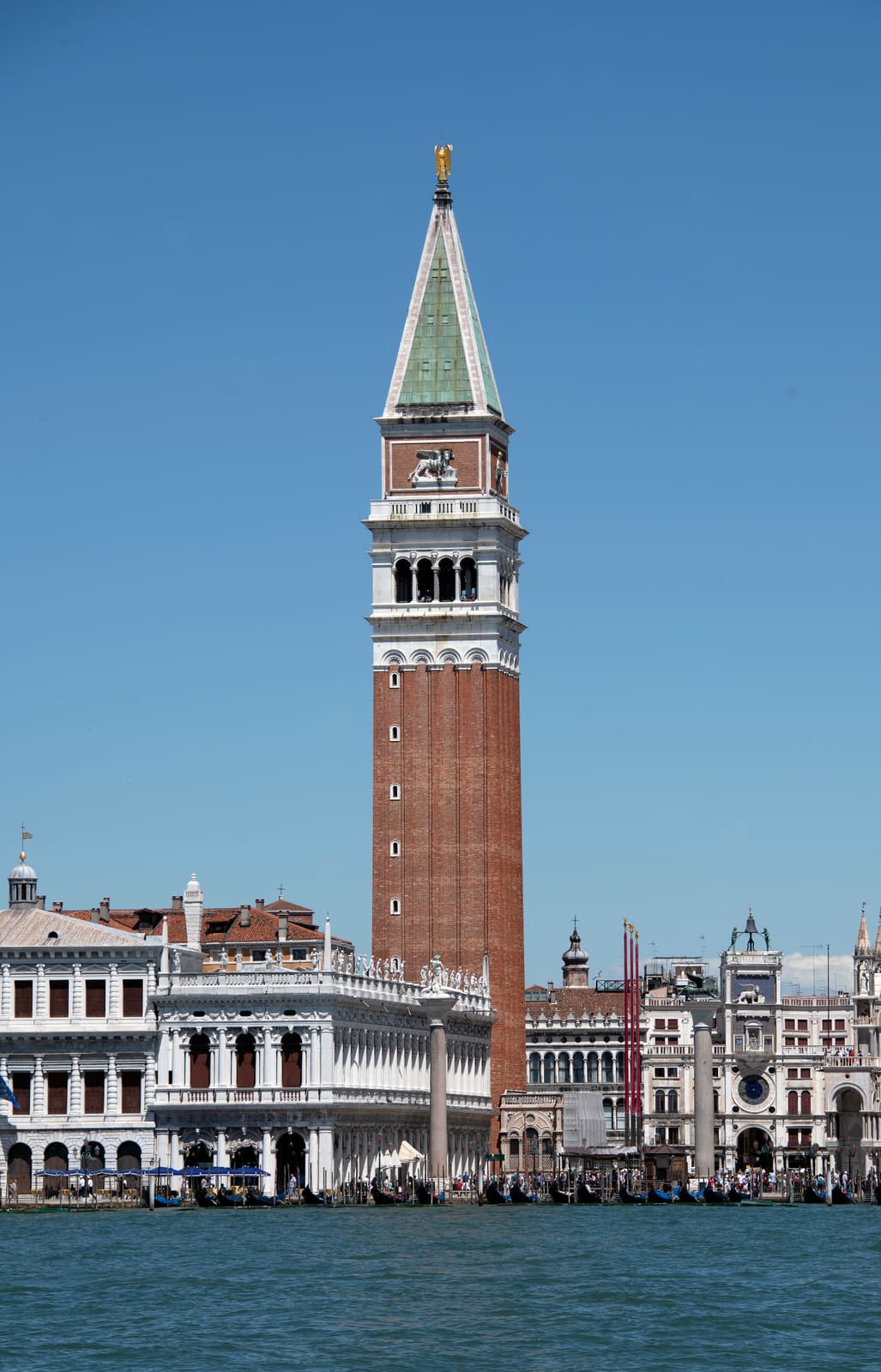
St Mark's Campanile
- viewpoint
- Price: €10 - €13
- Opening hours: 09:00 - 19:00
History
The Campanile's story starts around 888, when Doge Pietro Tribuno had a watchtower raised on this spot to guard the political heart of Venice; over the following centuries it grew taller and doubled as a lighthouse for ships approaching the lagoon, reaching something close to its final proportions by the mid-12th century under Doge Domenico Morosini. It took its definitive Renaissance form in 1514, when architect Giorgio Spavento reworked the tower's upper section and belfry; he died before the work was finished, and Bartolomeo Bon completed it to give the Campanile the silhouette Venetians still call "el paron de casa," the master of the house, watching over Piazza San Marco.
At 98.6 metres, it remained the tallest structure in Venice for centuries — until, without any warning, it collapsed completely on the morning of 14 July 1902. Remarkably, the only casualty was the caretaker's cat; the square had been cleared just in time. The city rebuilt the tower "dov'era, com'era" (where it was, as it was), brick by brick and at public expense, adding a passenger lift for visitors that the original never had. It reopened on 25 April 1912, St Mark's feast day and, by tradition, exactly a thousand years after the first tower's foundations were laid.
Did you know?
Before the 1902 collapse, five bells hung in the belfry, each tied to a specific civic duty and rung at a different moment of Venetian life. The Marangona, the largest, marked the start and end of the working day for the city's carpenters; the Trottiera summoned members of the Great Council, who had to trot their horses to reach the Doge's Palace in time; the Nona rang at the ninth hour to mark midday prayer; the Mezza Terza called the faithful to Mass and opened Senate sessions; and the grimmest of the five, the Maleficio, tolled to announce executions ordered by the feared Council of Ten. Only the Marangona survived the collapse intact — the other four were recast as a gift from Pope Pius X.
The Campanile's silhouette proved influential well beyond Venice: the Metropolitan Life Insurance Company Tower, completed on New York's Madison Square in 1909 and briefly the tallest building in the world, was explicitly modelled on it, right down to the pyramidal, gilded spire.
Good to know
Unlike almost every other bell tower in Venice, the Campanile has no stairs for visitors — an elevator carries you straight to the viewing platform, making it one of the easiest panoramic viewpoints in the city to reach. From the top, the view stretches over the domes of St Mark's Basilica, the rooftops of Venice, the lagoon islands, and on especially clear days, the distant Alps.
Queues build quickly once cruise groups arrive, so an early-morning or early-evening visit is best for both light and crowds; a combined ticket that also covers the Loggetta and the San Marco yard gallery can be booked online ahead of time. Note that the tower occasionally closes for short periods during strong bora winds, for visitor safety.