
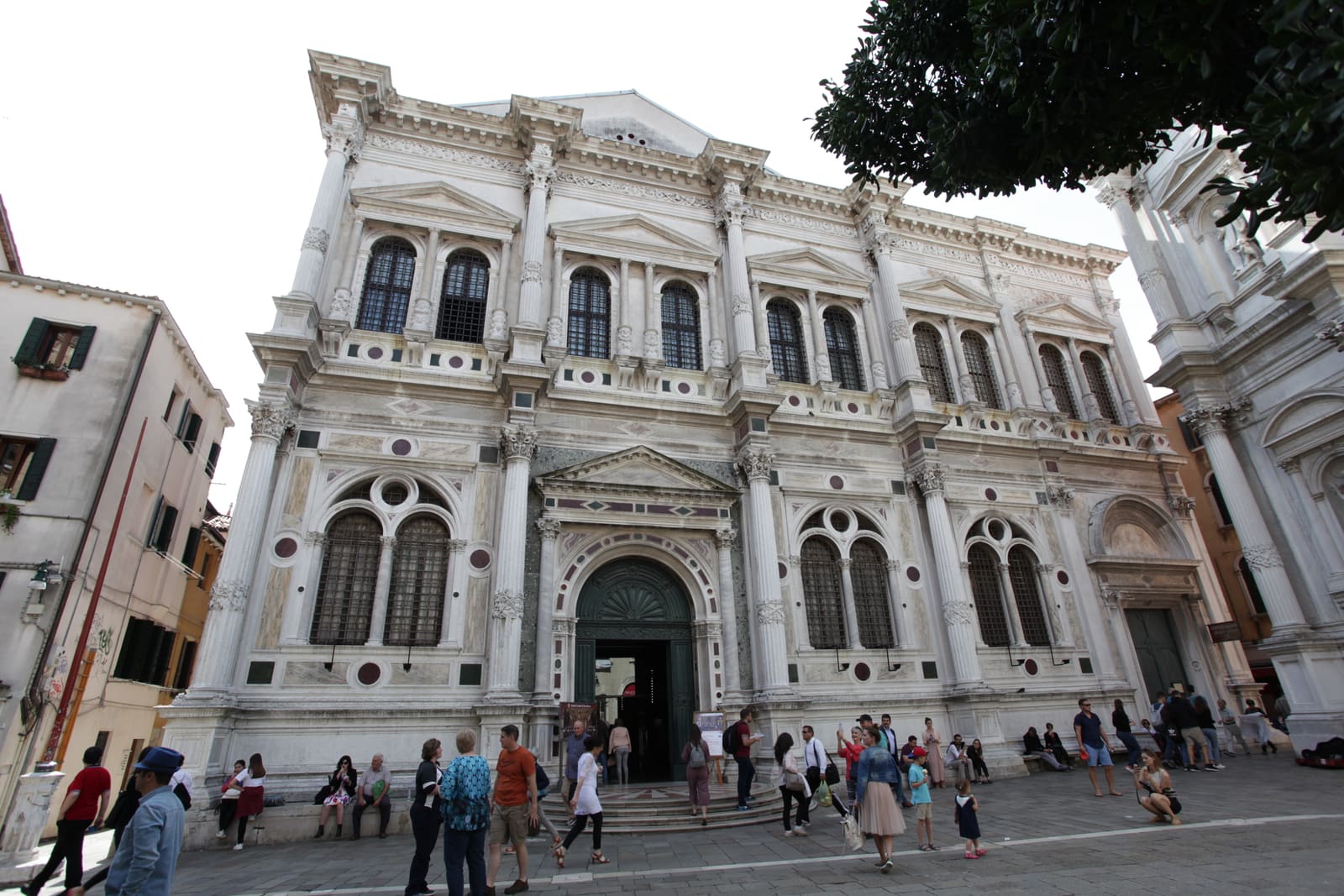
Scuola Grande di San Rocco
- art-museum
- historic
- Price: €10 - €12
- Opening hours: 09:30 - 17:30
History
The Scuola Grande di San Rocco was founded in 1478, not as a school in the modern sense but as a confraternity — a lay brotherhood of Venetian citizens organized around charitable works and devotion to Saint Roch, a saint widely invoked against the plague. Its wealth and prestige grew quickly, and by the early 16th century the brotherhood was ready to build a headquarters to match its standing.
Construction of the current building ran from 1515 to 1560 and passed through the hands of a succession of architects: Bartolomeo Bon began the work in 1517, Sante Lombardo took over in 1524, Antonio Scarpagnino carried the project forward from 1527 until his death in 1549, and Giangiacomo dei Grigi completed the facade in 1560. The overlapping styles of these four architects are still visible if you look closely at the building's exterior — no single hand dictated its final appearance.
Tintoretto's Cycle
In 1564, the confraternity opened a competition to decorate the ceiling of the Sala dell'Albergo, inviting the leading painters of Venice — among them Paolo Veronese and Federico Zuccari — to submit preparatory sketches. Jacopo Tintoretto instead had a full-sized, finished canvas of Saint Roch in Glory quietly installed in the ceiling before the judging even began. When challenged, he insisted this was simply how he worked, and offered the painting to the confraternity as an outright gift, knowing its own bylaws obliged the brothers to accept any donation made in the saint's honor. The scheme worked, and Tintoretto walked away with the commission.
He went on to spend more than two decades on the building, covering the ground-floor hall, the upper hall, and the Sala dell'Albergo with over sixty canvases between 1564 and 1587, essentially wallpapering the interior with his own painting. The most celebrated of them, a vast and turbulent Crucifixion filling one wall of the Sala dell'Albergo, is widely regarded as the summit of his career.
Did you know?
The composer Giovanni Gabrieli served as the confraternity's organist from 1585 until his death in 1612, a period when San Rocco's musical establishment rivaled that of the Basilica di San Marco itself; the English travel writer Thomas Coryat left an admiring account of the performances he heard here in the early 1600s.
Centuries later, the building's halls hosted a very different kind of premiere: on 23 September 1958, Igor Stravinsky conducted the first performance anywhere of his choral work Threni, written for that year's Venice Biennale festival of contemporary music, inside the same rooms where Tintoretto had worked four centuries earlier.
Good to know
The Scuola is open daily, generally from 09:30 to 17:30, and tickets cost around €10 to €12. A small hand mirror, or simply resting your neck now and then, makes studying the ceiling paintings in the upper hall far more comfortable than staring straight up for an hour.
The building stands right beside the Basilica dei Frari, one of Venice's great Gothic churches, so the two are easily seen together in a single visit to the San Polo district; guided tours combining both sites are widely available if you'd rather not navigate the artwork's iconography alone.