
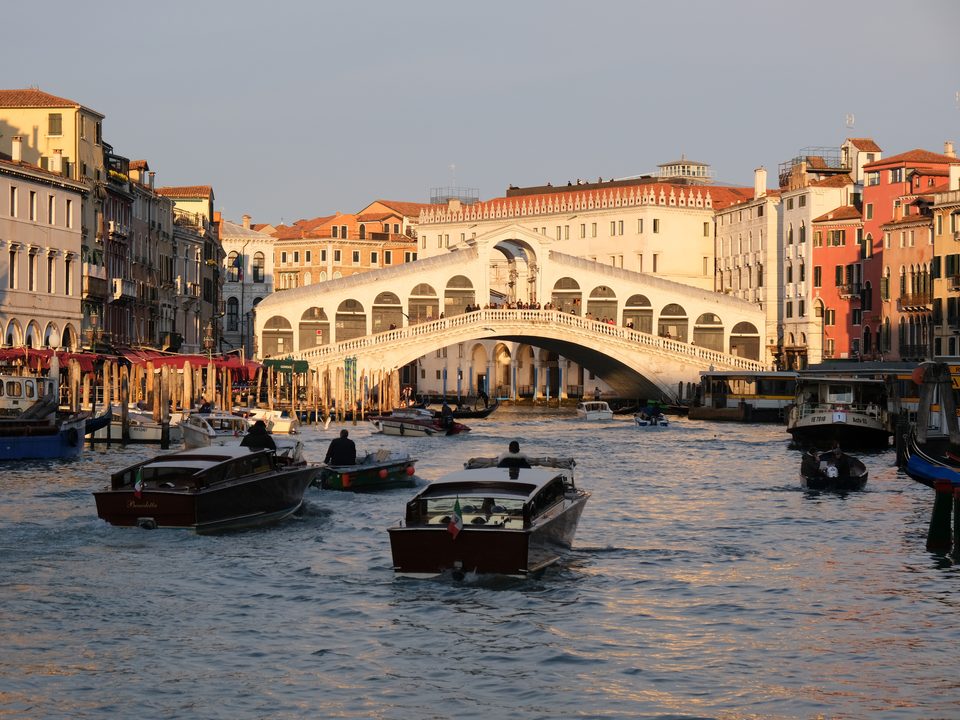
Rialto Bridge
- bridge
- Price: Free
- Opening hours: Always open
Book a guided tour of Venezia
Skip the line and see Venezia with a local guide.
History
The stone bridge standing today is only the fourth crossing on this stretch of the Grand Canal, and it replaced a run of wooden predecessors that kept failing under the weight of the crowds. The most dramatic collapses came during two great civic occasions — a wedding procession for the Marquis of Ferrara in 1444, and a further collapse on the Rialto side of the bridge in 1524 — after which the Republic finally accepted that timber wasn't going to hold.
A design competition followed, and — according to a story told more often than it's verified — even Michelangelo, Palladio, and Jacopo Sansovino are said to have submitted multi-arch proposals that were rejected because they would have obstructed the busy boat traffic below; most historians treat this as civic legend rather than documented fact. What is certain is that the single-arch design by the Venetian engineer Antonio da Ponte was approved in 1588, and the bridge — resting on roughly 12,000 wooden piles driven into the mud to support its weight — was completed in 1591.
Shops and market
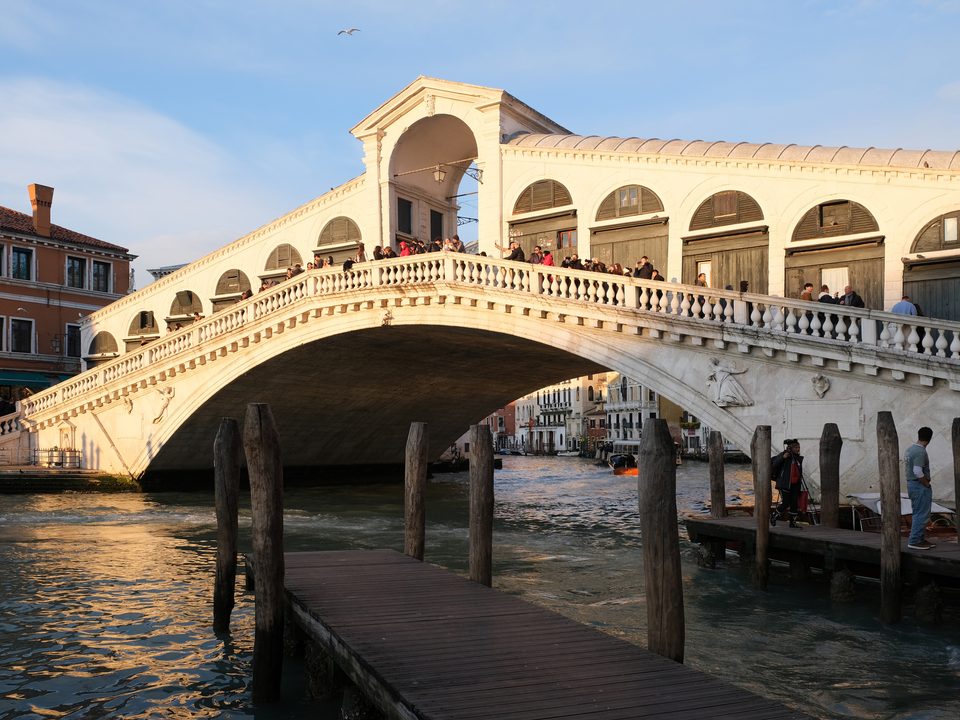
The bridge's sloped sides still carry two parallel rows of small shops built directly into its structure, a commercial arrangement that goes back to da Ponte's original design and traditionally leaned toward goldsmiths and jewelers — a trade Rialto is still associated with today, even as souvenir stalls have crept in.
Just beyond the bridge on the San Polo side spreads the Rialto Market, split between the Erbaria (fruit and vegetables) and the Pescheria (fish, housed in a Neo-Gothic hall from 1907) — one of the oldest trading sites in Venice, with roots reaching back roughly a thousand years. It's liveliest early in the morning and closed on Sundays (the fish stalls also rest on Mondays), so arrive by 8 or 9am to see it in full swing.
Did you know?
A local legend claims Antonio da Ponte struck a deal with the devil to guarantee the bridge's success, promising the soul of the first living creature to cross it; to outwit him, da Ponte reportedly sent a rooster over first — only for the devil to take his revenge by making da Ponte's own wife the first human to set foot on it.
For more than two and a half centuries, this was the only way to cross the Grand Canal on foot — Venice's first alternative crossing, the Ponte dell'Accademia, wasn't built until 1854, followed decades later by the Ponte degli Scalzi; today only four bridges span the entire canal.
Good to know
The top of the arch is the classic vantage point for photos of the Grand Canal's boat traffic, but it gets crowded fast — come at sunrise or after dinner to have the view largely to yourself, and expect the bridge itself to feel more like a busy commercial street than a quiet monument during the day.
There's no ticket or opening hours to worry about, since it's a public bridge crossed on foot around the clock; the best free view of the whole structure, arch and all, is from a vaporetto on the Grand Canal or from the riva just downstream on either bank.