
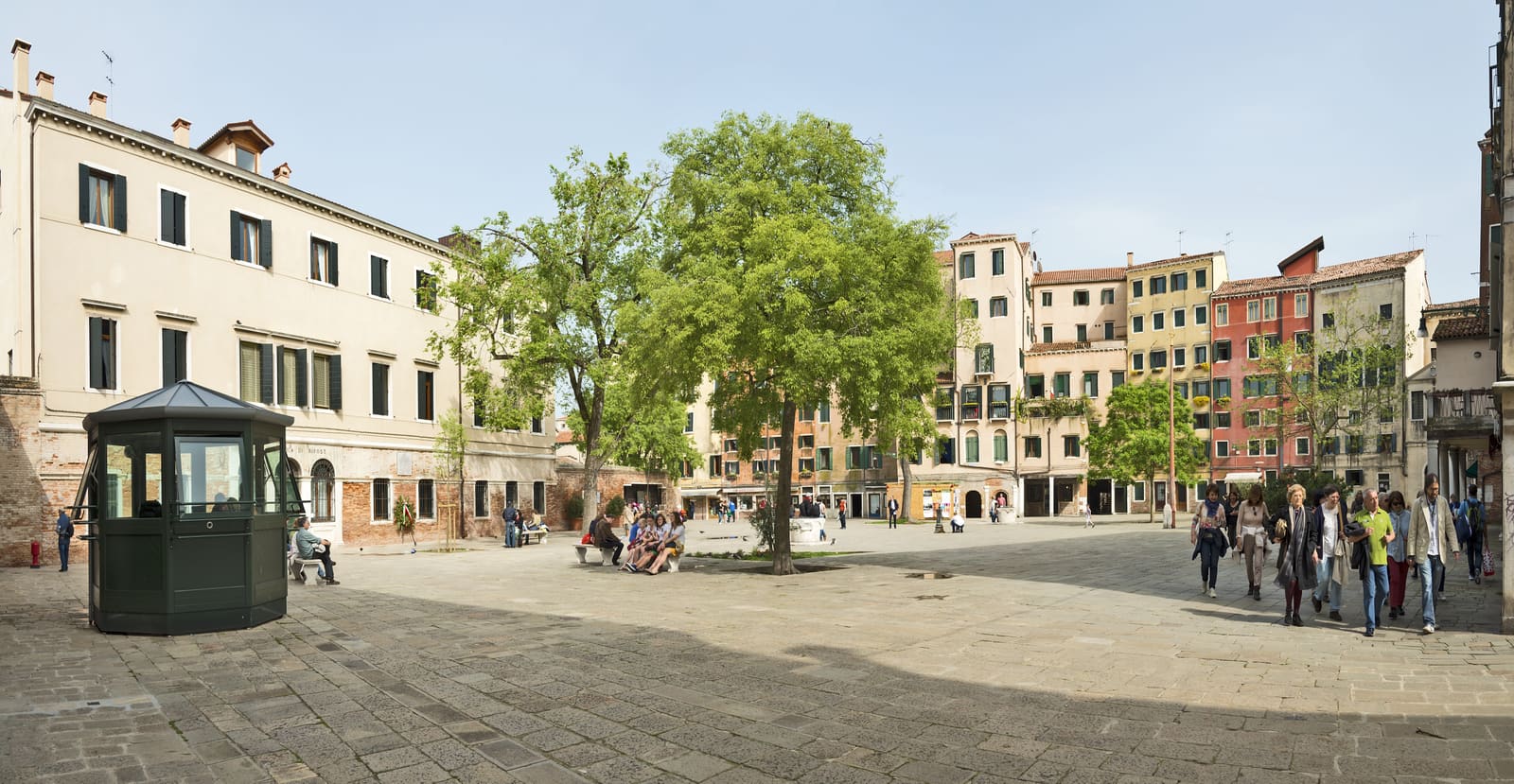
Jewish Ghetto
- old-town
- Price: €10 - €12 for the Jewish Museum and synagogue guided tour; the square itself is free to visit
- Opening hours: 10:00 - 17:30, closed Saturdays
History
On 29 March 1516, the Venetian Senate issued a decree confining the city's Jewish residents to a small island in the Cannaregio district, on the site of a former foundry. It was the first time anywhere in Europe that a Jewish community was compelled by law into a segregated, enclosed quarter — and the site's name gave the world the word "ghetto" itself, now used for segregated neighbourhoods everywhere.
That original enclosure, later known as the Ghetto Nuovo, proved too small almost immediately. Venice annexed the adjoining Ghetto Vecchio in 1541 and, in 1633, added a third area, the Ghetto Nuovissimo, to house a growing population of Ashkenazi, Italian, and Sephardic Jews, many of them refugees from persecution elsewhere in Europe. By 1555 the quarter held 923 residents within a city of roughly 160,000; that number kept climbing over the following century, reaching several thousand at its peak in the mid-1600s.
Five Synagogues, Five Communities
Because the ghetto's footprint could never expand outward, its community built upward instead, raising tenements of seven or eight storeys around the central Campo del Ghetto Nuovo — unusually tall for Venice at the time. Five historic synagogues, or scholae, were founded here between the 16th and 17th centuries to serve different communities: the Scuola Grande Tedesca and the smaller Scuola Canton for Ashkenazi Jews from German-speaking lands, the Scuola Italiana for worshippers following the Italian rite, and the Scuola Spagnola and Scuola Levantina for Sephardic Jews who had fled Spain, Portugal, and the Ottoman Levant.
Because Jewish law holds that nothing should stand between a synagogue and the sky, all five were built on the uppermost floor of otherwise ordinary-looking tenement buildings, with no grand facade to mark them from the street — a discretion that still makes them easy to walk past unnoticed. The Scuola Spagnola and Scuola Levantina remain in occasional use for services today; all five can be visited only as part of a guided tour organised through the Jewish Museum on the square.
Did you know?
The word "ghetto" is generally thought to derive from the Venetian "geto" or "getto," meaning "casting," a reference to the copper foundry that once stood on the site and cast cannon for the Republic's navy. The theory isn't perfectly tidy — Venetian "geto" has a soft g, while "ghetto" has a hard one — so a few linguists have proposed other origins over the years, but the foundry explanation remains by far the most widely accepted.
Until 1797, the ghetto's gates were locked every night by Christian guards, whose wages were paid by the Jewish community itself, and the surrounding canals were patrolled by boat to enforce the curfew; the gates reopened each morning at the sound of the Marangona, the great bell of St Mark's Campanile. They came down for good on 11 July 1797, torn apart amid public celebration within weeks of Napoleon's conquest of the Republic.
Good to know
The Jewish Museum and its guided synagogue tours are closed on Saturdays for Shabbat, as well as on Jewish holidays, so plan a weekday or Sunday visit. Tours in English and Italian run regularly through the day and are the only way to see inside the synagogues, since none of them can be entered independently.
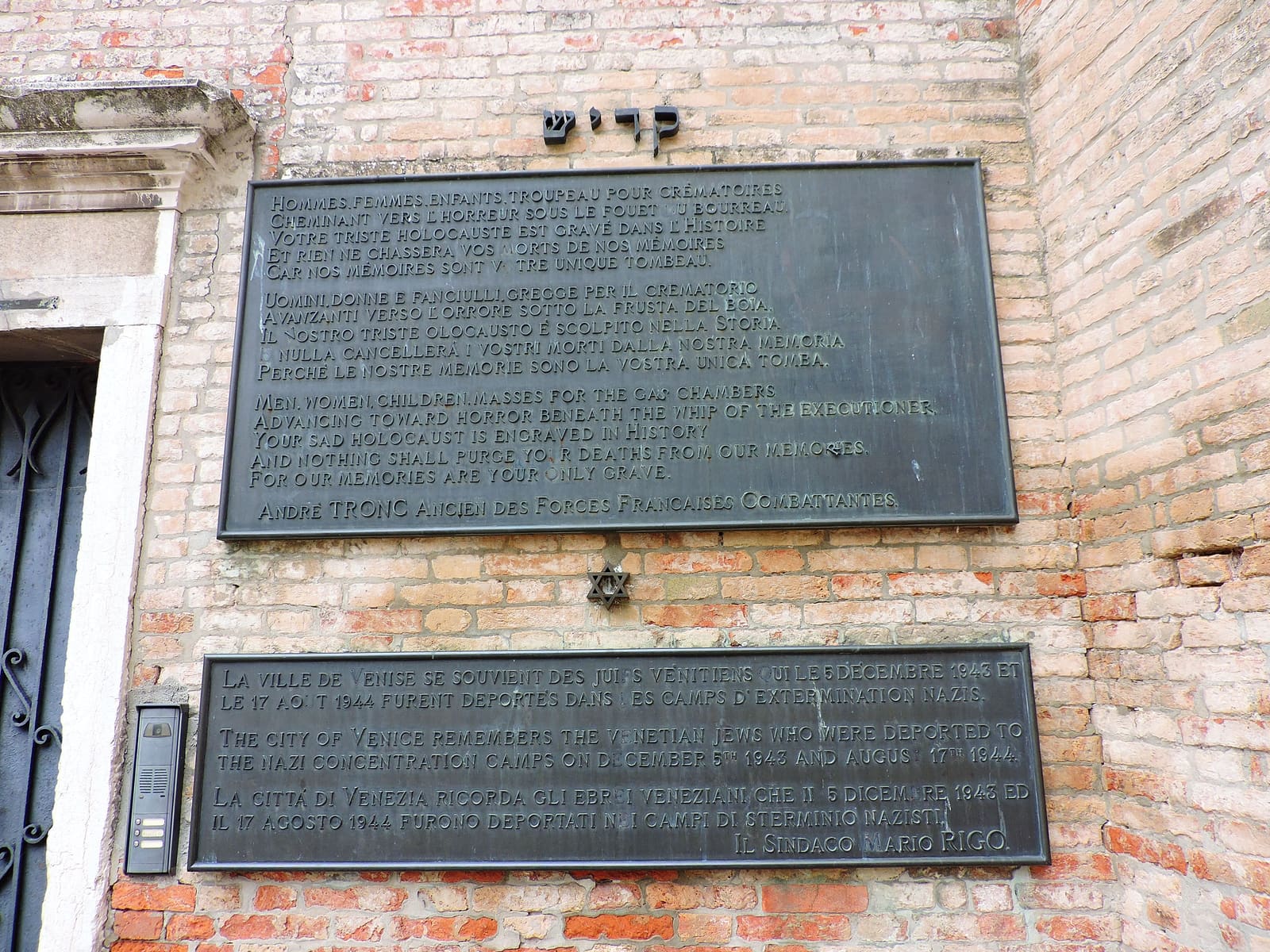
A small Jewish community still lives around the square today, alongside a kosher bakery and a handful of Judaica shops. In the campo itself, a memorial of bronze relief panels by the sculptor Arbit Blatas, installed in 1980, commemorates the roughly 246 Venetian Jews deported to Nazi concentration camps on 5 December 1943 and 17 August 1944, according to the names recorded there; only a handful are known to have survived. It is a quiet, sobering stop that is very much part of any visit to the ghetto.