
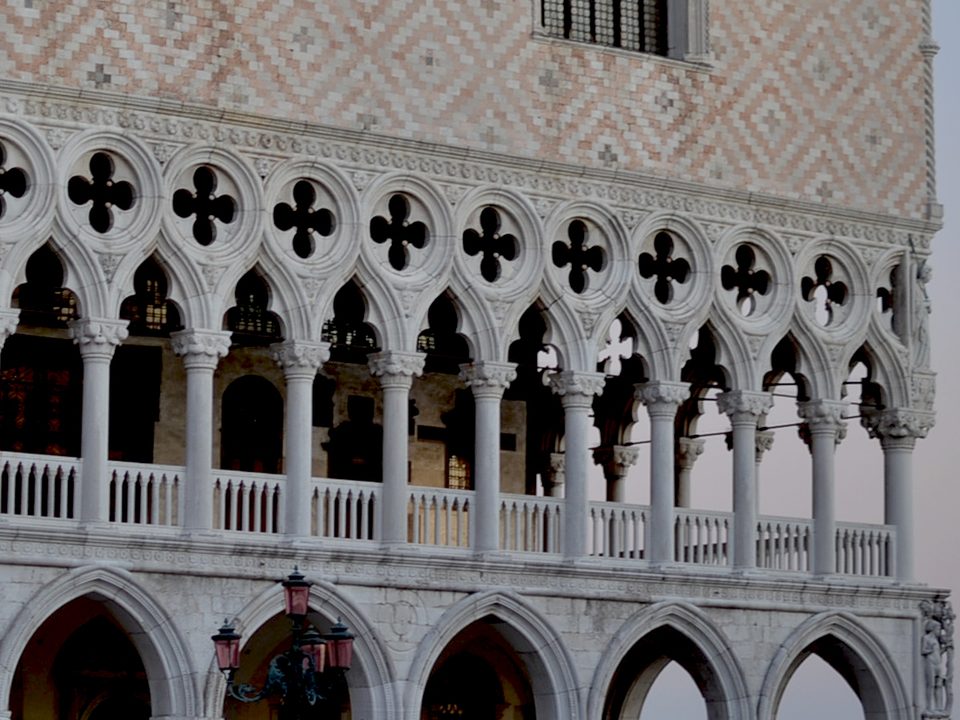
Doge's Palace
- palace
- Price: €30 - €35
- Opening hours: 09:00 - 19:00 (shorter hours Nov-Mar)
History
For nearly a thousand years, this pink-and-white Gothic palace was the residence of the doge and, at the same time, the seat of the Republic's government, law courts, and prisons — the whole machinery of Venetian rule packed into one building on Piazza San Marco. The structure seen today largely dates from Gothic rebuilding campaigns of the 14th and 15th centuries, layered over earlier fortified palaces on the same site, with an open arcaded ground floor supporting a loggia and a heavy upper wall whose pink-and-white diamond pattern in Verona marble and Istrian stone became one of the most recognizable facades in Venice.
The standard visit today covers far more than the palace itself: a single ticket also grants access to the Museo Correr, the Archaeological Museum, and the Monumental Rooms of the Biblioteca Marciana, all connected around Piazza San Marco, and the tour route ends by crossing the enclosed Bridge of Sighs into the old prison cells on the far side of the canal.
The Great Council Hall
A fire broke out in the palace in December 1577 and badly damaged the Sala del Maggior Consiglio, the vast hall where the Republic's ruling council met, ruining a fresco painted there two centuries earlier by Guariento di Arpo. The Senate opened a competition to replace it with a new work on canvas, awarding the commission jointly to Paolo Veronese and Francesco Bassano; when Veronese died in 1588, the job passed to Jacopo Tintoretto, who completed the enormous painting with the help of his son Domenico and a busy workshop.
The result, known as "Il Paradiso," is often cited as the largest oil painting on canvas in the world — roughly 22 by 9 metres and crowded with some 500 figures. Visitors reach the hall by way of the Scala d'Oro, the "Golden Staircase" built under Jacopo Sansovino's design in the mid-16th century, its gilded stuccowork designed as a suitably grand ceremonial route for anyone granted an audience with the doge.
Did you know?
Scattered through the palace's corridors and courtyards are "bocche di leone," stone letterboxes carved as lion's mouths, into which any citizen could drop an anonymous written accusation addressed to a specific magistracy. They fed Venice's enduring reputation as a state built on surveillance and denunciation, even if historians note the system was also open to abuse by anyone settling a personal score.
Among the palace's prisoners was Giacomo Casanova, held in the Piombi — the cramped cells under the lead roof, named for the material that made them stifling in summer — after his arrest in 1755. His escape the following year, scaling the roof and slipping past guards, remains one of the few successful breakouts from the prison on record, and Casanova later turned it into one of the most famous episodes of his memoirs.
Good to know
The standard entry is sold as the St Mark's Square Museums ticket, covering the Doge's Palace together with the Correr Museum, the Archaeological Museum, and the Monumental Rooms of the Biblioteca Marciana; the other three are meant to be visited the same day as the palace, so it's worth planning a full afternoon around the ticket rather than splitting the visit across days. Booking online ahead of time is strongly advisable in high season, when queues at the door can run long.
For a very different view of the building, the separate "Secret Itineraries" guided tour leads through the doge's hidden offices, the torture chamber, and the Piombi cells where Casanova was held — it must be reserved in advance and isn't included in the standard ticket.