
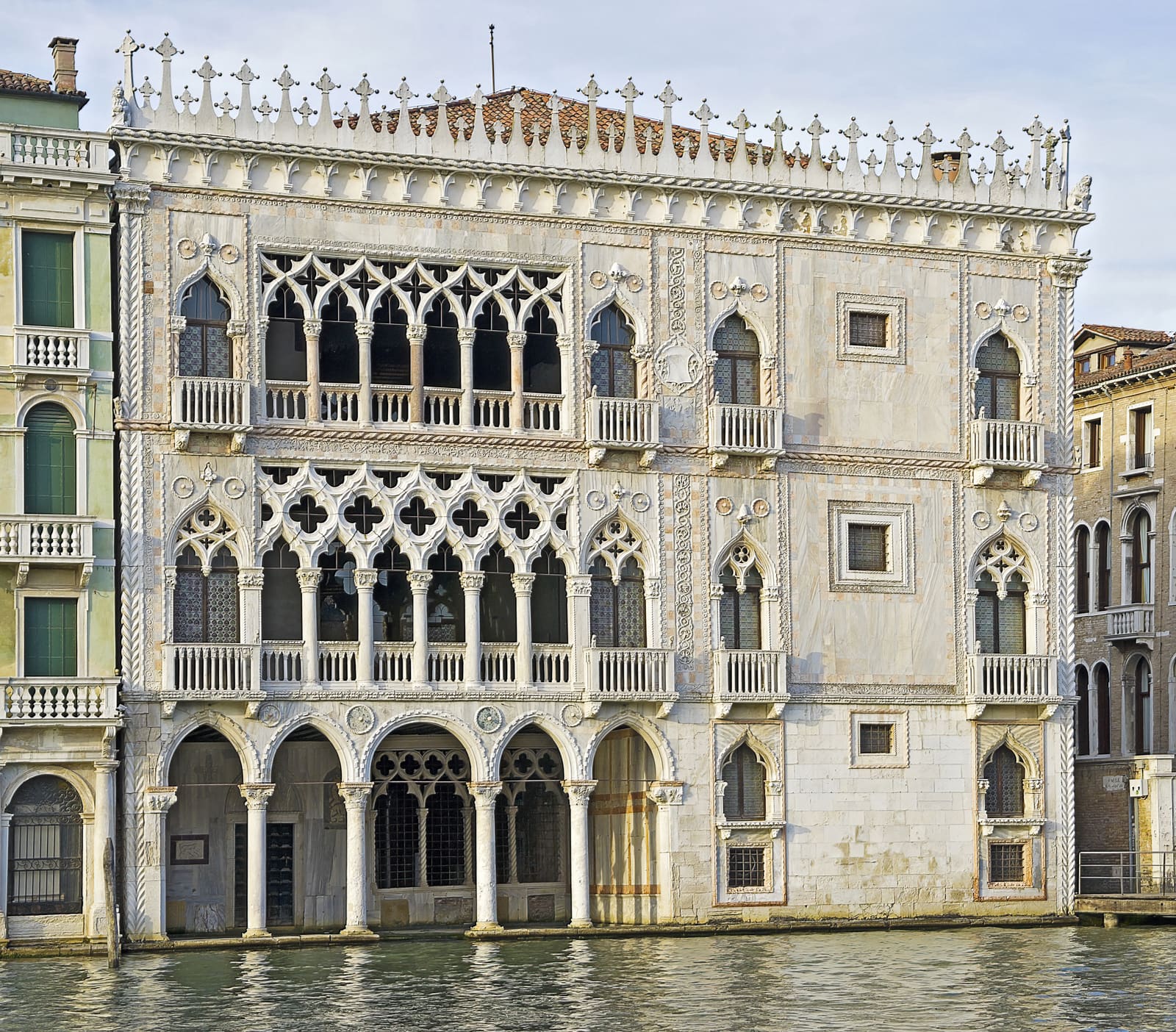
Ca' d'Oro
- palace
- art-museum
- Price: €6 - €9
- Opening hours: 08:15 - 19:15
Book a guided tour of Venezia
Skip the line and see Venezia with a local guide.
History
Marino Contarini, a Venetian nobleman from a family that had already given the Republic several doges, commissioned this palace on the Grand Canal in 1421, and construction continued through the following decade and a half. The work was led by Giovanni Bon and his son Bartolomeo, together with the Milanese sculptor Matteo Raverti, and the finished building took its name — Ca' d'Oro, "House of Gold" — from the lavish gilding and polychrome paint that once covered its intricately carved facade.
Blending Venetian Gothic tracery with Byzantine ornament and touches of influence absorbed through Venice's trade with the Islamic world, the palace is now considered the finest surviving example of Venetian Gothic domestic architecture. As with most Grand Canal palazzi, the decoration was concentrated almost entirely on the water-facing front, the side meant to be seen and admired from passing boats, while the other elevations remained comparatively plain.
From decline to museum
After Contarini's descendants died out, the palace passed through a succession of owners and slowly fell into disrepair. Its lowest point came in 1846, when the ballerina Marie Taglioni bought it and carried out a renovation that, rather than preserving what remained, stripped away much of its original Gothic character — including the ornate spiral staircase and the carved wellhead that Bartolomeo Bon had made for the courtyard in 1427-28.
Baron Giorgio Franchetti acquired the ruined palace in 1894 and spent much of the rest of his life and fortune trying to undo the damage, painstakingly reconstructing the Gothic staircase, tracking down and reinstating original elements, and laying new mosaic floors partly of his own design. In 1916 he donated the building and his art collection to the Italian state; the museum opened to the public in January 1927, five years after Franchetti's death.
Did you know?
Almost none of the original gold survives today — it wore away long before the 19th-century restorations even began — so what visitors actually see is the bare stone tracery that once framed it, so delicate it's often compared to lace. It's a slightly ironic twist for a building whose fame rests on a name describing a decoration that vanished centuries ago.
The undisputed highlight of Franchetti's collection is Andrea Mantegna's "Saint Sebastian," considered important enough that Franchetti had a small chapel-like space built specifically to display it, and it remains the museum's single most celebrated work alongside his holdings of bronzes, tapestries, and sculpture.
Good to know
The museum is closed on Mondays. It sits directly on the Grand Canal in the Cannaregio district and has its own vaporetto stop, Ca' d'Oro, on line 1 — and because the collection is compact, a visit comfortably fits into less than an hour.
Make time to step onto the loggia overlooking the Grand Canal: the view across the water toward the Rialto fish market is one of the best framed canal vistas available from inside any Venetian palace.