
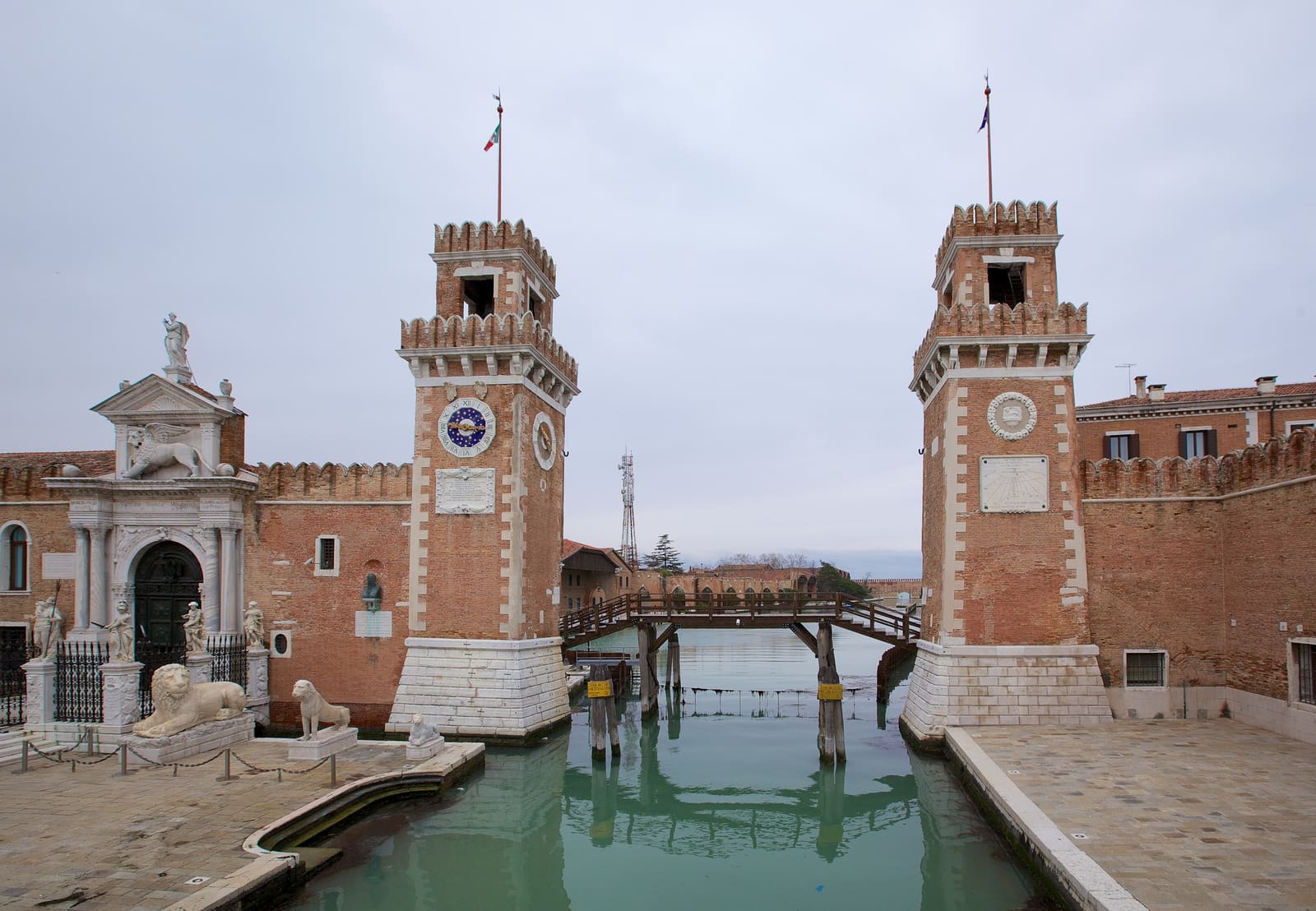
Venetian Arsenal
- historic
- Price: varies — mostly viewable from outside or by boat; some areas open only during Biennale exhibitions
Book a guided tour of Venezia
Skip the line and see Venezia with a local guide.
History
The Arsenal was founded around 1104 under Doge Ordelafo Faliero, and its very name traces back to Venice's trade contacts with the Arab world: "arsenale" descends from the Arabic "dar as-sina'a," roughly "house of craft," which entered Venetian dialect as "arzanà" long before it settled into Italian. What began as a state-run shipyard grew dramatically over the following centuries, most notably with the Arsenale Nuovo added in 1320 and, later, the Arsenale Nuovissimo in the 16th century, until the complex sprawled across something like 15% of the entire city.
At its early-16th-century peak, the Arsenal employed roughly 16,000 workers and could turn out nearly a galley a day by relying on standardized, interchangeable parts and pre-assembled hulls fitted out on a kind of production line — one of history's earliest examples of large-scale industrial organization, centuries ahead of its time. It was already famous enough in Dante's day that he used its year-round vats of boiling pitch, kept ready for waterproofing hulls, as the simile for the burning tar of Hell in Canto XXI of the "Inferno."
Did you know?
The Arsenal's workers, known as the arsenalotti, were far more than laborers: they formed a privileged caste within Venetian society, with steady wages and a status that came with ceremonial duties at the very top of the Republic. They stood guard at the election of each new doge, and by tradition it was the arsenalotti who carried the doge's coffin at his funeral — a striking sign of how central the shipyard was to the Republic's identity.
The monumental gateway to the complex, the Porta Magna, dates from around 1460 and is flanked by ancient stone lions looted as war trophies. The most celebrated, the so-called Piraeus Lion, was seized in Greece and brought to Venice in 1687 by the naval commander Francesco Morosini after his campaign against the Ottomans. Carved into its shoulders and flanks are lengthy runic inscriptions, believed to have been cut by Scandinavian mercenaries sometime in the 11th century — making them among the oldest graffiti anywhere in Venice. And in 1593, while teaching at the nearby University of Padua, a young Galileo Galilei took on a role as technical consultant to the Arsenal, advising its engineers on shipbuilding and ballistics problems that later fed directly into his groundbreaking work on the strength of materials.
Good to know
Much of the Arsenal remains an active naval facility and is closed to casual visitors, so the classic way to see it is from the water: a vaporetto ride past the entrance canal, or a walk along the perimeter walls, gives a real sense of its scale even without going inside.
Selected areas — most notably the vast Corderie (former rope works) and the covered Gaggiandre dry docks — open to the public periodically as exhibition venues for the Art and Architecture Biennale; checking the current Biennale calendar is the most reliable way to plan a visit inside the walls.