
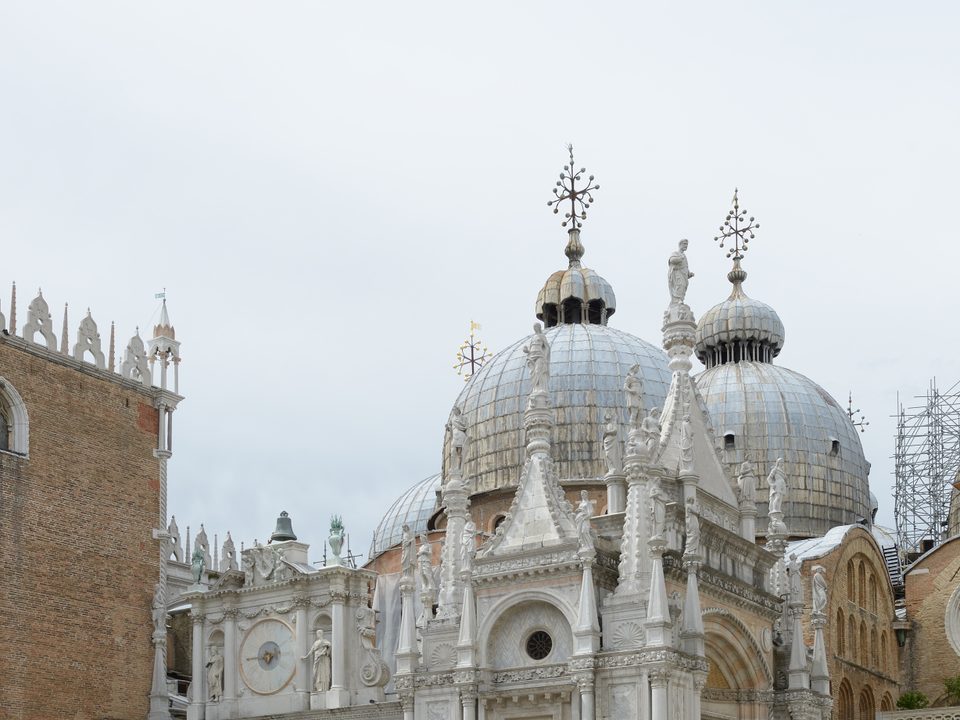
St Mark's Basilica
- sacred
- Price: €10 - €36
- Opening hours: 09:30 - 17:15 (Sun from 14:00)
History
According to tradition, in 828 two Venetian merchants smuggled the body of the evangelist Mark out of Alexandria, reportedly concealing it beneath a layer of pork to discourage the Muslim customs officials searching their cargo from inspecting it too closely. The relics reached Venice the following year, and a first church to house them was built beside the Doge's Palace by 832; it burned down during a rebellion in 976 and was rebuilt, only to be judged unworthy of the city's growing ambitions within another century.
The basilica standing today was begun around 1063 under Doge Domenico Contarini and consecrated in 1094 under Doge Vitale Falier, deliberately modeled on the long-vanished Church of the Holy Apostles that Emperor Justinian had built in Constantinople — a cross-shaped plan crowned by five domes, one over the crossing and one over each arm. Over the following centuries the church became Venice's great showcase of Byzantine wealth and imported craftsmanship, and by the time restorers began cataloguing it in the 19th century, its interior surfaces carried close to 8,000 square meters of gold-ground mosaic.
The Pala d'Oro and the Bronze Horses
Behind the high altar stands the Pala d'Oro, a jewel-encrusted altarpiece of gold and enamel panels begun in the 10th century and enlarged and reset several times over the following four hundred years; its final Gothic frame, added in the early 14th century, holds hundreds of pearls and gemstones around scenes worked in Byzantine cloisonné enamel, much of it acquired or looted from Constantinople.
On the loggia above the main entrance stand four bronze horses, probably cast in the classical world and looted from Constantinople during the Fourth Crusade's sack of the city in 1204; they were mounted on the facade around the mid-13th century and became one of the most recognizable images of Venice itself. The originals now live inside the basilica's museum, out of reach of the weather, while the horses visitors photograph on the loggia today are faithful copies.
Did you know?
The basilica's nickname, "Chiesa d'Oro" or Church of Gold, comes from the accumulated centuries of mosaic work inside it — some of the earliest panels date to the late 11th century, and additions and restorations continued as late as the 1800s, meaning the gold ceiling visitors see today is really a patchwork of nearly a thousand years of craftsmanship rather than a single unified design.
The building was never just Venice's cathedral in the ordinary sense — for most of the Republic's history it was the doge's private chapel, attached directly to his palace, and it only became the seat of the Patriarch of Venice, the city's actual bishop, after Napoleon's conquest at the start of the 19th century.
Good to know
Since July 2025, every visitor must book a timed entry slot online in advance through the basilica's official ticketing site; on-the-spot ticket purchases at the door have been discontinued, so arriving without a reservation means you likely won't get in that day. Slots run in short intervals throughout the day, and it's worth booking as early as your travel dates allow, since popular times fill up.
The standard timed entry covers only the nave; seeing the Pala d'Oro up close and visiting the museum where the original bronze horses are kept both require separate, additional tickets bought on top of the basic entry. Budget extra time for both if either is a priority, since they're accessed from different points inside the church.