
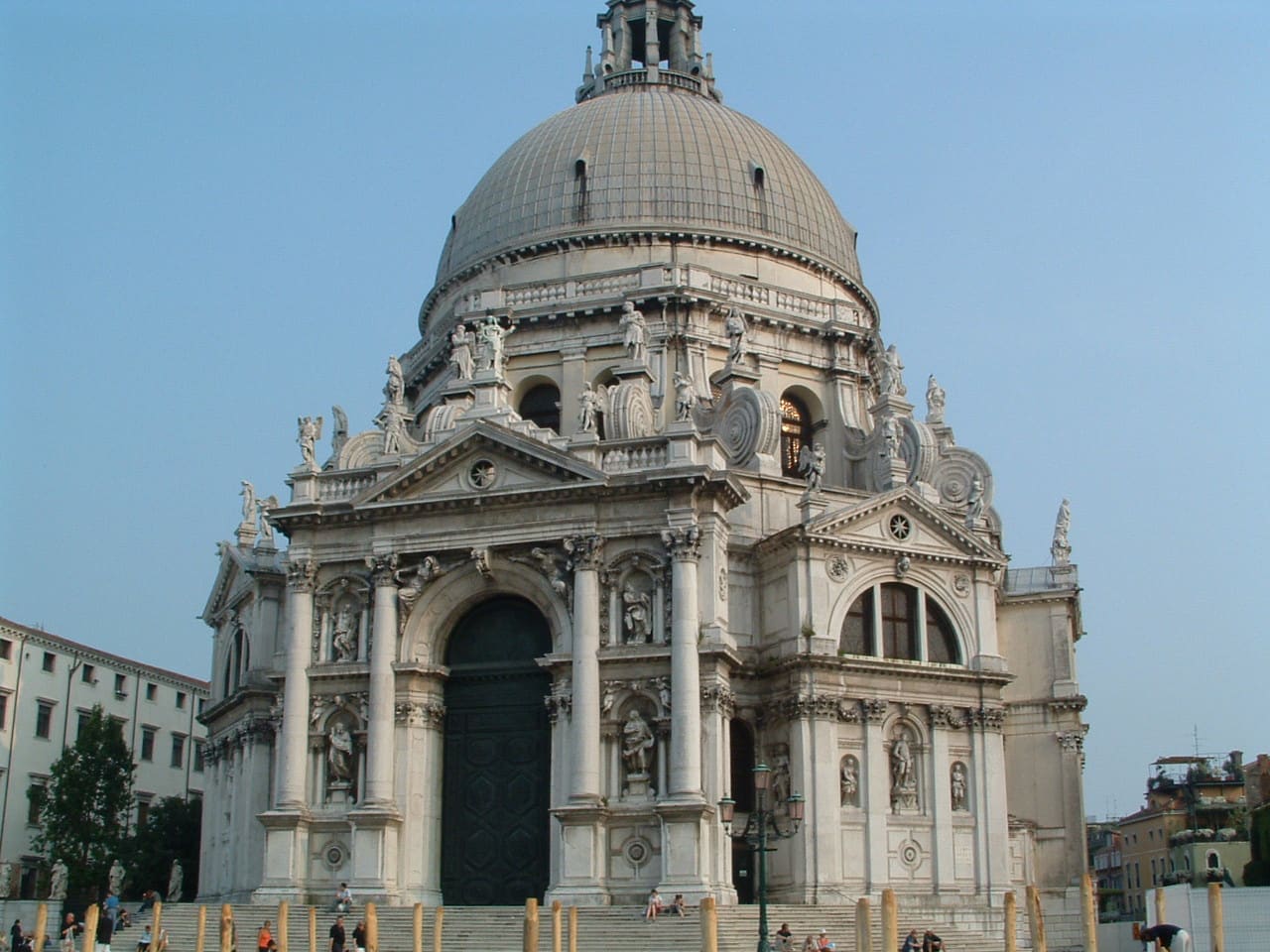
Santa Maria della Salute
- sacred
- Price: free entry to the church; small fee for the sacristy, around €4
- Opening hours: 09:00 - 12:00 and 15:00 - 17:30
Book a guided tour of Venezia
Skip the line and see Venezia with a local guide.
History
In 1630, plague swept through Venice, killing nearly a third of its population — as many as 46,000 people in barely a year. In gratitude for the city's eventual deliverance, the Republic's Senate vowed to build a church dedicated to the Virgin Mary, and in 1631 opened a competition for its design. The winning proposal came from Baldassare Longhena, an architect still in his early thirties who had trained under Vincenzo Scamozzi and had yet to build anything on this scale.
Construction began that same year on a site at the mouth of the Grand Canal so unstable that builders drove more than a million wooden piles into the mud to support the weight of the church above. The work stretched on for over half a century: Longhena died in 1682, five years before the basilica was finally consecrated in November 1687, and it fell to his pupil Antonio Gaspari to see the project through to completion. The result — an octagonal plan crowned by twin domes, one large and one smaller behind it — has anchored the Venice skyline ever since.
The Feast of the Salute
Every 21 November, Venice honors the vow that gave the church its existence. Before dawn, workers assemble a temporary bridge of moored boats across the Grand Canal, linking the Salute to the San Marco side near Campo Santa Maria del Giglio, and for one day pedestrians can cross the water on foot rather than by bridge or vaporetto. Locals and visitors alike walk the pontoon bridge to light a candle inside, continuing a tradition that has run almost without interruption since the 17th century.
The date falls on the Catholic feast of the Presentation of the Virgin, which conveniently gave the plague-deliverance vow a fixed place on the calendar. The atmosphere on the day mixes the devotional with the festive — stalls selling candles and roasted chestnuts line the approach to the church — and the celebration has spread well beyond Venice itself, still observed in Trieste and other towns once ruled by the Republic.
Did you know?
The icon on the high altar, known as the Madonna della Salute or Panagia Mesopantitissa, is a Byzantine work of the 12th or 13th century that Venetian tradition — almost certainly more legend than fact — once attributed to Saint Luke himself. It reached Venice only in 1670, brought from Candia (present-day Heraklion) on Crete by the naval commander Francesco Morosini after the island fell to the Ottomans, and so it predates the church around it by centuries.
Longhena's dome has drawn painters for more than three hundred years: Canaletto and Francesco Guardi painted it in the 18th century, J.M.W. Turner sketched it from the water in the 19th, and Claude Monet set up his easel nearby during his brief stay in Venice in 1908. Inside, the sacristy holds paintings by Titian alongside a large Tintoretto canvas of the Marriage at Cana, a quieter counterpart to the grandeur of the exterior.
Good to know
Entry to the church itself is free, but the sacristy — where most of the paintings hang — charges a small admission, usually around €4. Opening hours run in two blocks, roughly 09:00 to 12:00 and again from 15:00 to 17:30, with the doors closed over the midday hours, so plan a morning or late-afternoon visit rather than arriving at lunchtime.
The Salute sits at the tip of Dorsoduro, right where the Grand Canal meets the Giudecca Canal, an easy walk from the Accademia bridge or a short ride on the vaporetto to the Salute stop. Punta della Dogana, Venice's contemporary art museum, occupies the old customs house just steps away, making it easy to combine both stops in a single outing.