
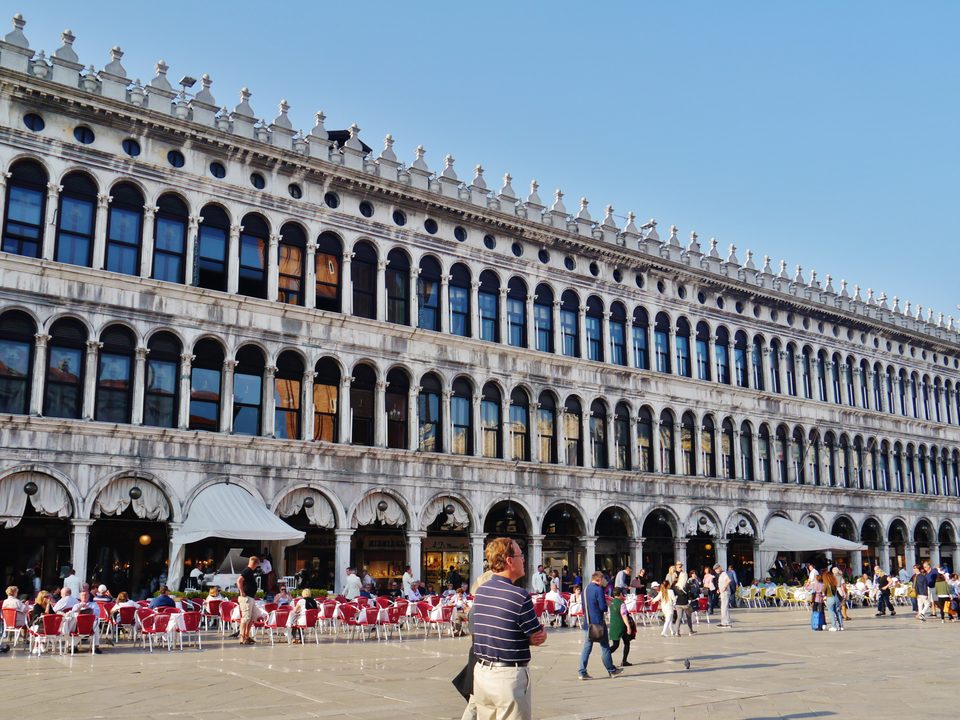
Piazza San Marco
- piazza
- Price: Free
- Opening hours: Always open
Book a guided tour of Venezia
Skip the line and see Venezia with a local guide.
History
This is the only square in Venice called a "piazza" — every other open space is a "campo" (or "campiello"). Its present form dates to the 12th century, when Doge Sebastiano Ziani filled in the Rio Batario, a canal that once cut across the area, and annexed surrounding orchards and convent land to roughly quadruple its size, giving the square the trapezoidal shape it retains today.
The complex of arcaded buildings wrapping three sides took centuries to complete: the Procuratie Vecchie, on the north side, went up from 1514, while the Procuratie Nuove opposite were built between 1582 and 1640, drawing on designs by Jacopo Sansovino and Vincenzo Scamozzi. Napoleon, after annexing Venice in 1797, had the west end closed off with a new wing — the so-called Ala Napoleonica — demolishing a church to complete the enclosure, and is popularly (if unreliably) credited with calling the square "the finest drawing room in Europe."
The cafés of the square
Beneath the arcades of the Procuratie Nuove, Caffè Florian has been serving coffee since 29 December 1720, when it opened as "Alla Venezia Trionfante" — making it one of the oldest coffee houses in the world still in continuous operation. It was also, notably, the only Venetian café that admitted women in the 18th century, which helped draw regulars such as Casanova, and later Goethe, Byron, and Proust.
Its longtime rival, Caffè Quadri, opened across the square in the 1770s and became popular with the Austrian officers who occupied Venice in the 19th century, while Florian stayed the haunt of Venetian patriots — a rivalry with real political edge at the time. Both cafés still keep small orchestras playing under their porticoes on summer evenings, a tradition running for more than two centuries, though a seat at either comes with a hefty cover charge on top of the coffee.
Did you know?
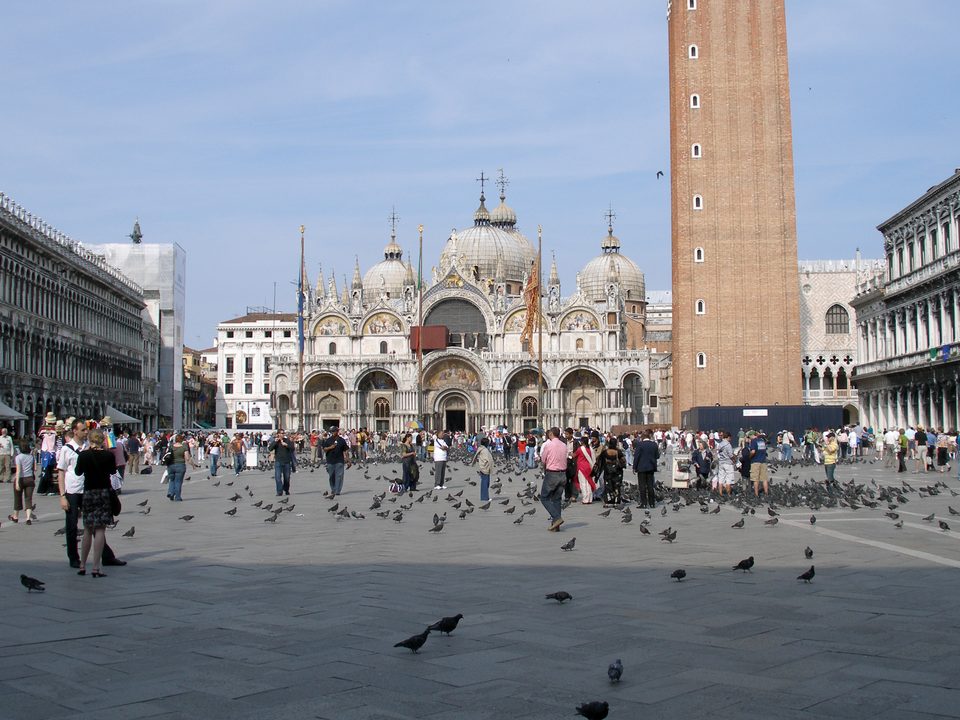
Napoleon's line about the square being "the finest drawing room in Europe" is one of Venice's most quoted phrases — even though historians can't actually trace it to any document he wrote or signed, and it may be more legend than fact.
Until 2008, tourists could buy bags of corn from vendors to feed the square's pigeons, a Venice photo-op cliché for generations; the city then banned the practice outright to protect the marble facades, and pigeon numbers in the square have reportedly fallen by roughly half since.
Good to know
Piazza San Marco sits at the lowest point in Venice, so it's the first place to flood during acqua alta, the seasonal high tide that peaks between October and December; when water is forecast, the city lays down raised wooden walkways (passerelle) so pedestrians can cross without wading.
The square is at its calmest — and most photogenic — early in the morning or after dark, once the day-trip crowds thin out; a coffee at Florian or Quadri comes with a cover charge for the live orchestra, so check the menu's fine print before sitting down if you just want an espresso at the counter.