
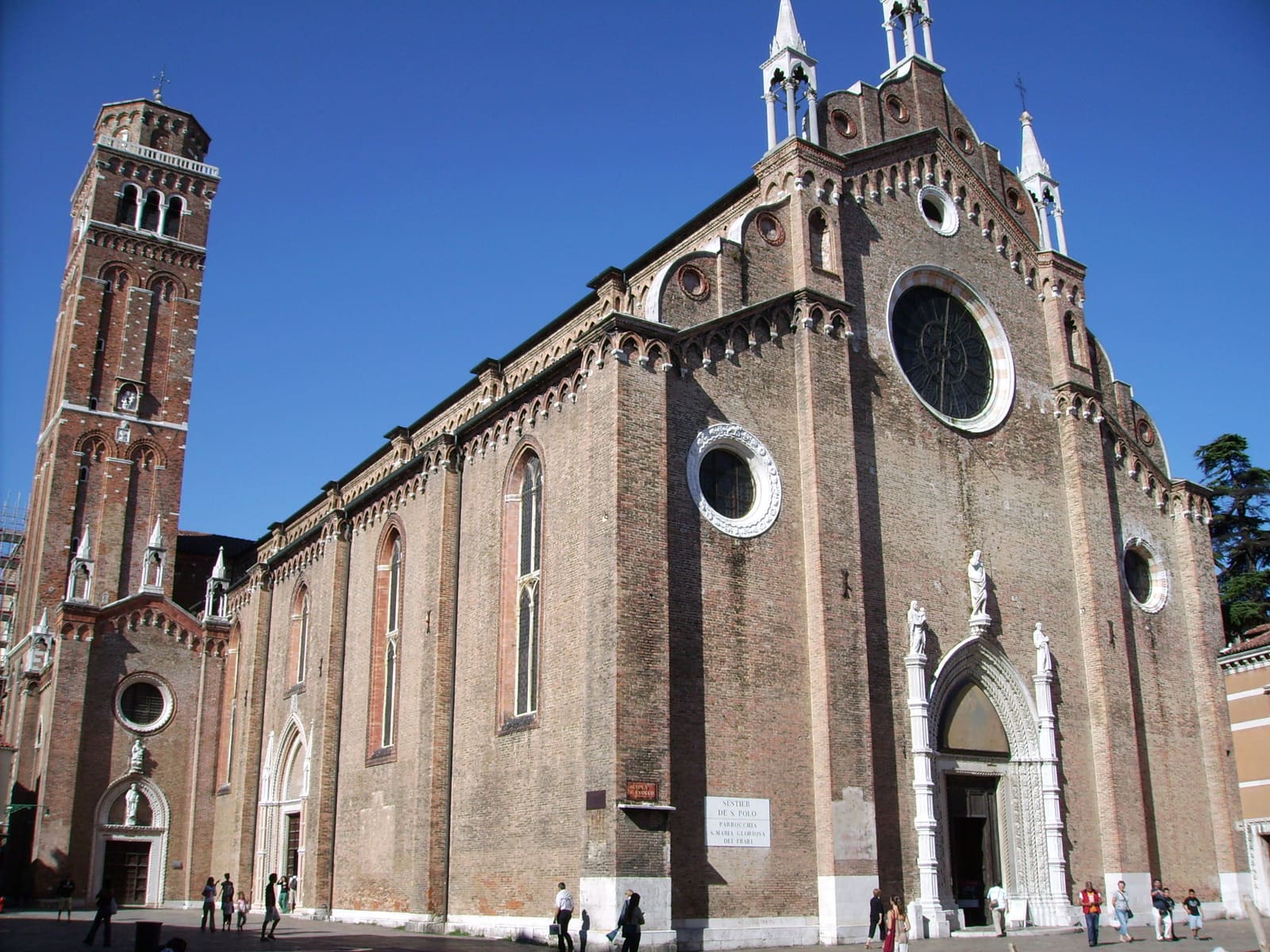
Frari Basilica
- sacred
- Price: €5 - €8
- Opening hours: 09:00 - 18:00
History
Franciscan friars reached Venice in the early 13th century and were granted this plot in the sestiere of San Polo, where a first, more modest church rose soon after 1231. It proved too small within a few generations, and in 1250 the papal legate Cardinal Ottaviano Ubaldini laid the first stone of the much larger brick basilica that stands today. Construction dragged on for well over a century under a succession of builders, including the father-and-son architects Jacopo and Pier Paolo Celega, who completed the bell tower — still the second-tallest in Venice after St Mark's — in 1396.
Built of humble brick rather than stone or marble, the finished basilica became one of the largest churches in the city, with a nave that runs roughly 100 metres and rises 28 metres to the ceiling. Despite its size, the Frari remains the only church in Venice to keep its original rood screen — the carved stone and marble partition separating the friars' choir from the lay congregation — which was ripped out of nearly every other Venetian church once the Counter-Reformation favoured open, unobstructed naves.
The Masterpieces Inside
Nothing prepares first-time visitors for the altar wall: Titian's "Assumption of the Virgin," a nearly seven-metre-high altarpiece unveiled in 1518 that was so radically ambitious in scale and colour it instantly made the young painter Venice's leading artist. Titian returned to the church a few years later for the "Pesaro Madonna" (1519–1526), commissioned by the Pesaro family for their own chapel, in which he broke with convention by pushing the Virgin off-centre and turning the flanking saints into active participants in the scene rather than static onlookers.
Two more masterpieces complete the collection: Giovanni Bellini's "Frari Triptych" of 1488, a serene Madonna and saints prized for its subtle handling of light, and Donatello's wooden "St John the Baptist" of 1438 — one of the rare works by the great Florentine sculptor found outside Tuscany, carved during a brief spell working in the Veneto.
Did you know?
The Frari is also a mausoleum. Titian himself is buried here, having died during the plague of 1576, and the composer Claudio Monteverdi — who spent his last three decades as choirmaster at St Mark's — rests in a chapel nearby. The sculptor Antonio Canova is buried here too, beneath a striking white marble pyramid unveiled in 1827.
That pyramid has a twist: Canova designed it in the 1790s as a monument to Titian, but the fall of the Venetian Republic and a shortage of funds meant it was never built in his lifetime. When Canova himself died in 1822, his own pupils reused his unrealised design for Titian's tomb — reworked instead as their teacher's own. A separate monument to Titian, in an entirely different style, wasn't added to the church until the 1850s.
Good to know
The Frari stands in Campo dei Frari in the San Polo district, a short walk from the Rialto Bridge, and is included on the Chorus Pass that covers several of Venice's most important parish churches. As in any active place of worship, modest dress covering shoulders and knees is expected.
Because Mass is still celebrated here regularly, opening hours run shorter on Sundays and holy days, when visits are limited around the service schedule — check the current timetable before planning a Sunday visit. The Scuola Grande di San Rocco, with its own great cycle of Tintoretto paintings, sits just around the corner and pairs naturally with a Frari visit.