
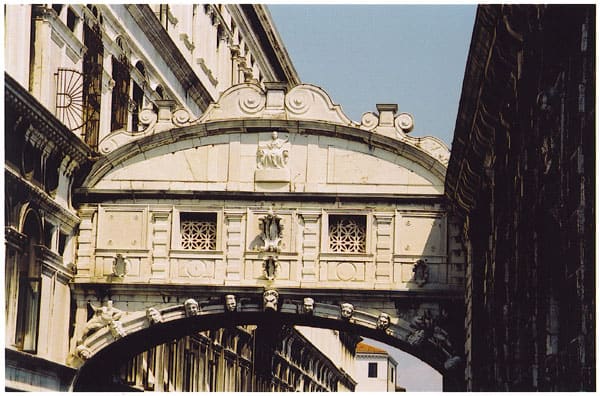
Bridge of Sighs
- bridge
History
Antonio Contin — a nephew of Antonio da Ponte, the engineer behind the Rialto Bridge — designed this enclosed span across the narrow Rio di Palazzo, built in white Istrian stone in the early years of the 1600s. Rather than a single open passage, it holds two separate corridors, keeping prisoners being led one way from ever crossing paths with those going the other. Its purpose was purely functional: connecting the interrogation rooms inside the Doge's Palace to the cells of the Prigioni Nuove, the "New Prison" built across the canal after the palace's own cramped dungeons ran out of room.
The bridge's small openings are covered with stone lattice grilles rather than left as open windows, framing only narrow, barred slivers of the lagoon and the mouth of the Grand Canal. That detail matters, because the view most visitors imagine — condemned prisoners drinking in one last glimpse of Venice — is largely a later romantic invention rather than the bridge's original design intent.
Did you know?
The English name isn't Venetian at all: it comes from Lord Byron, who wrote in Childe Harold's Pilgrimage, "I stood in Venice, on the Bridge of Sighs, a palace and a prison on each hand," picturing it as the last look condemned prisoners took of the city before disappearing into their cells. It's a beautiful image, but historians note that by the bridge's day most people crossing it were being held for minor offenses or debts rather than facing execution — the doom-laden legend owes more to 19th-century Romanticism than to Venetian judicial reality.
The bridge became so famous that it spawned imitators far from the lagoon: Cambridge's St John's College has its own covered "Bridge of Sighs" (the resemblance mostly begins and ends with being enclosed), Oxford's Hertford Bridge picked up the nickname despite actually looking more like the Rialto Bridge, and Pittsburgh's Allegheny County Courthouse has what's often called the closest replica of all, an enclosed walkway built in the 1880s to lead prisoners from the courthouse to the jail next door.
Good to know
You can't visit the Bridge of Sighs on its own — walking through its corridors is only possible as part of a Doge's Palace ticket, since the bridge is an internal passage of the palace-and-prison complex rather than a public walkway.
For the postcard view, skip trying to see it from inside and head instead to Ponte della Paglia, the bridge at the edge of Riva degli Schiavoni, or the gondola-filled canal directly beneath it — both offer the classic framed shot, and mornings before the tour groups arrive are the quietest time to get it.