
Burano
- old-town
History
Burano sits roughly 45 minutes by boat north of central Venice, a cluster of five small islets stitched together by footbridges. It has always lived off the lagoon — first as a community of fishermen, today as home to around 2,800 residents packed into one of the highest population densities anywhere in the lagoon — and its narrow canals and boats still recall that working past even as the crowds shift toward tourism.
The island has been known for fine needle lace since at least the 16th century, a craft historically produced by the women of fishing families while the men were out at sea. The tradition nearly died out until a brutally cold winter in 1872 left the lagoon frozen and fishing impossible; a group of Venetian noblewomen, backed by the patronage of Queen Margherita of Savoy, founded the Scuola dei Merletti (Lace School) that same year to give the island another livelihood. One elderly woman, Cencia Scarpariola, still remembered the old "punto in aria" stitch and passed it on to a new generation, and for decades Burano lace was sought after by European royalty. Industrial competition and the upheaval of the World Wars eventually closed the school in the 1970s, but a consortium revived it as the Lace Museum in 1981.
Did you know?
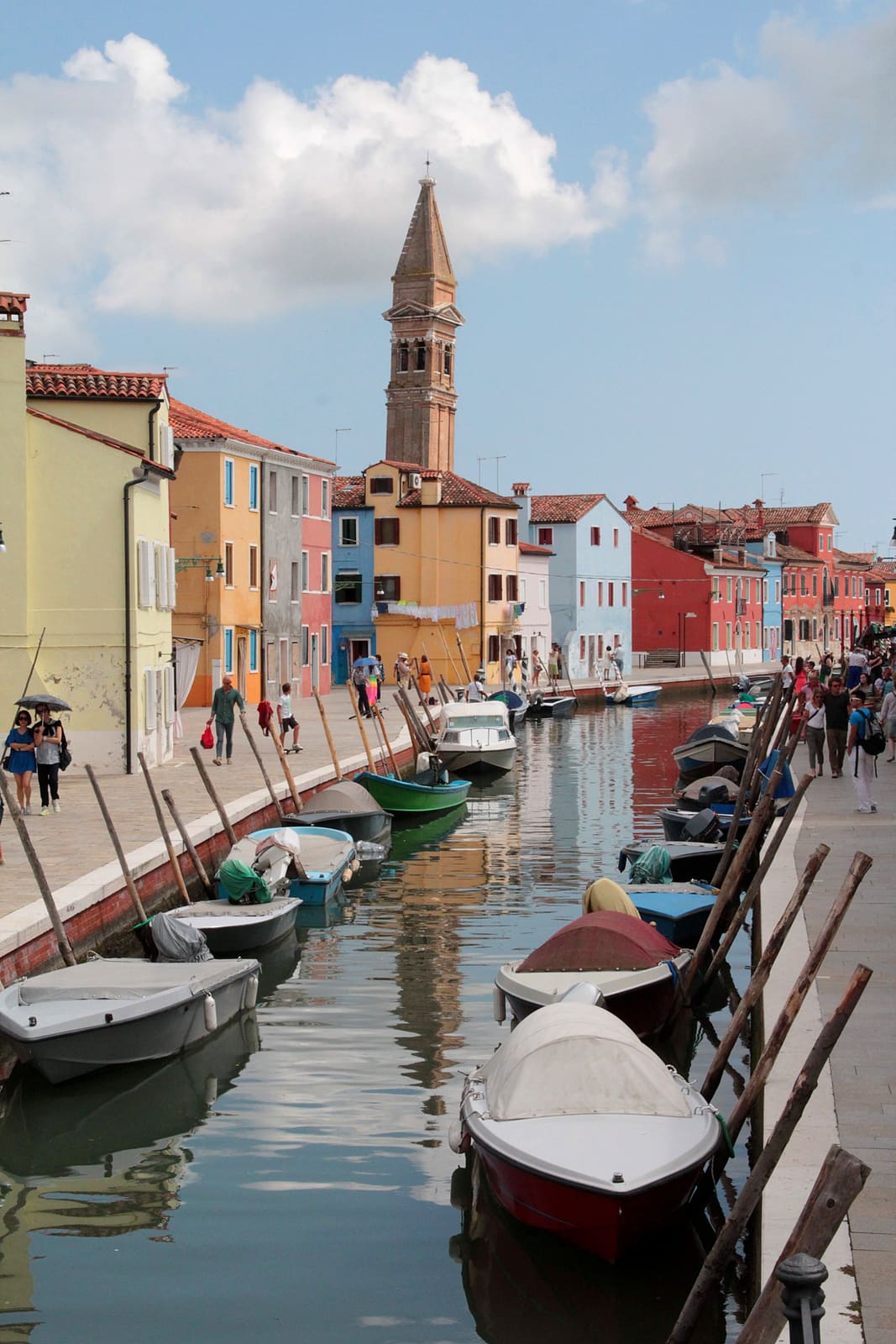
Burano's houses are painted in a strictly regulated palette of bright colors — residents who want to repaint have to apply to the local authority and choose from an approved list of shades. The most repeated explanation is that fishermen originally picked bold, distinct colors so they could spot their own house through the lagoon fog from the water; another version holds that the colors helped distinguish families who often shared the same surname on such a small island. Either way, the result is one of the most photographed streetscapes in Italy.
The island's church, San Martino, has its own quiet oddity: a roughly 53-metre bell tower that leans noticeably off vertical, a consequence of the same soft, waterlogged ground that makes building anything in the lagoon a challenge. Inside, the sacristy holds a "Crucifixion" painted by Giambattista Tiepolo around 1725-1727, a work influenced by Tintoretto's own treatment of the subject at the Scuola Grande di San Rocco in Venice.
Good to know
Vaporetto line 12 runs to Burano from Fondamente Nove, on Venice's northern edge, in about 45 minutes; many visitors combine the trip with neighboring Murano and Torcello on a single boat excursion rather than making three separate crossings.
Piazza Baldassare Galuppi, the island's main square, is the natural hub, home to the small Lace Museum and the Church of San Martino. Day-trip boats tend to arrive in a wave around midday, so early morning or late afternoon light is both quieter and far more flattering for photographs of the colored houses.