
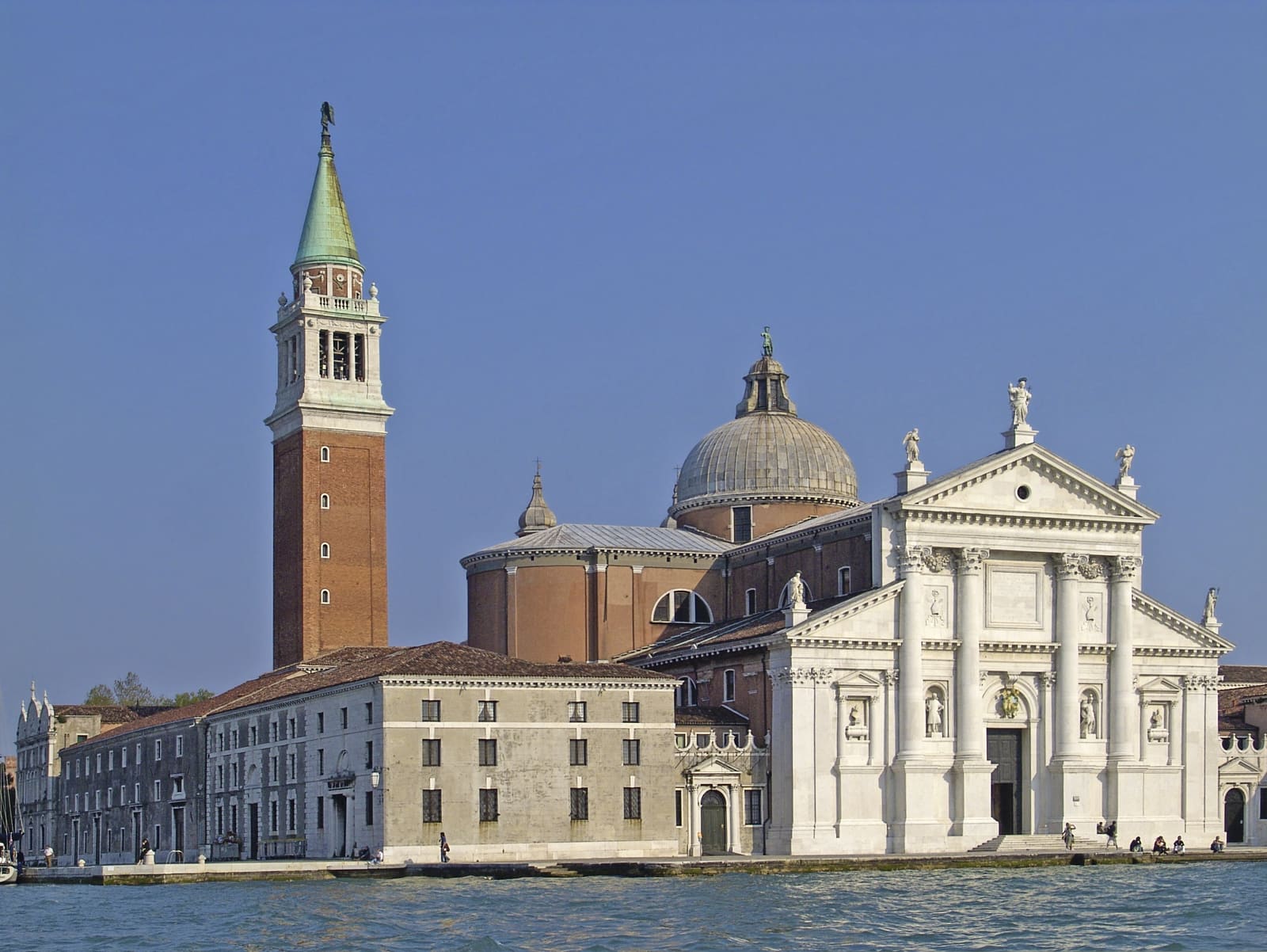
San Giorgio Maggiore
- sacred
- Price: free entry to the church; small fee (around €8) for the campanile lift with lagoon views
- Opening hours: 09:30 - 18:00
History
The island has likely been inhabited since Roman times, and takes its name from a church dedicated to St. George that stood here by 829. In 982, the doge Tribuno Memmo granted the island to the Benedictine monk Giovanni Morosini, who founded a monastery on the site — the beginning of a religious community that would remain here, with interruptions, for nearly a thousand years.
The monastery flourished for centuries as a center of learning and art, until Napoleon suppressed it after his conquest of Venice; the complex was then used as a military garrison under French, Austrian, and Italian rule for close to 150 years, leaving it badly degraded. Restoration only began in earnest in 1951, when the industrialist Vittorio Cini founded the Cini Foundation in memory of his son Giorgio, who had died in a plane crash two years earlier, dedicating it to reviving the monastery as a center for culture and research.
Palladio's church
The island's defining landmark is the Church of San Giorgio Maggiore, designed by Andrea Palladio starting in 1566. Palladio died in 1580 with the facade still unfinished, and it was completed to his design — with some refinements of his own — by fellow architect Vincenzo Scamozzi, bringing the building to completion around 1610. Its white marble facade, all classical columns and pediments modeled on Roman temple fronts, forms one of the most recognizable silhouettes on the entire lagoon, famously painted by Monet from across the water.
Inside, two large canvases by Tintoretto flank the high altar: The Last Supper and The Fall of Manna, painted in the artist's final years and among his most dramatic works, built around the same sharp use of light and shadow that defines his style. The church's brick campanile, rebuilt in the 18th century after its predecessor collapsed, offers an elevator ride to a view many consider even better than the one from the Campanile in Piazza San Marco — largely because this one includes the Piazza San Marco skyline itself in the frame.
Did you know?
Within the former monastery, the Cini Foundation maintains a rich library and archive open to scholars, alongside the open-air Teatro Verde, an outdoor amphitheater built in the 1950s that still hosts performances and events overlooking the lagoon.
The island is part of the UNESCO World Heritage Site "Venice and its Lagoon," inscribed in 1987 — a designation covering the historic city and its surrounding waters as a single, fragile ecosystem of art and engineering.
Good to know
The church holds Sunday morning services, during which tourist access to the nave is limited, so plan visits for other times of day if you want to explore freely; the campanile lift usually runs on a separate, small additional ticket.
The island sits just across the water from Piazza San Marco and is reached by a short vaporetto ride (line 2) rather than on foot, so budget a little extra time for the crossing — and check ahead, since access can occasionally be restricted for private events at the Cini Foundation.